
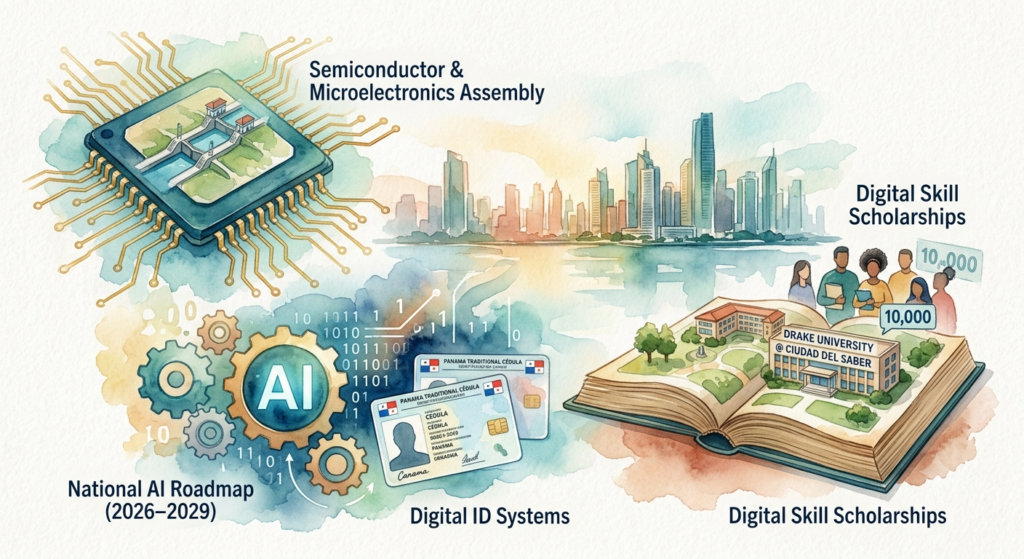
For foreign residents, investors, and corporate strategists, Panama’s technological transition represents a fundamental shift in the nation’s macroeconomic positioning. By committing $105 million toward advanced technologies and establishing a comprehensive regulatory framework through the National Agenda for Advanced Technologies, the administration of President José Raúl Mulino and SENACYT are building the infrastructure required for knowledge-based foreign direct investment (FDI).
Below is the strategic breakdown of how this $105 million initiative operates, the key international frameworks driving it, and where high-value opportunities lie for foreign capital and expat entrepreneurs.
1. The Semiconductor Nearshoring Opportunity: Testing, Packaging & Assembly
Global semiconductor manufacturing requires vast capital and supply chain security. Under the U.S. CHIPS and Science Act framework, Western nations are actively seeking trusted nearshoring allies to diversify microchip supply chains away from single-region vulnerabilities.
Panama’s geographical advantage, monetary stability (U.S. Dollar economy), and maritime connectivity make it a prime candidate for ATP (Assembly, Testing, and Packaging) operations—the downstream phase of microchip production.
Operational Key Milestones:
- The C-TASC Center: Operating out of the Technological University of Panama (UTP), the Center for Advanced Semiconductor Technology (C-TASC AIP) serves as the national R&D platform for microelectronics and printed circuit board (PCB) design.
- Global Academic Partnerships: SENACYT is currently funding Panamanian engineers pursuing master’s and doctoral degrees in microelectronics at Arizona State University—a global hub for semiconductor production—ensuring direct technology transfer back to Panama.
- Specialized Logistics Protocols: Leveraging Panama’s multimodal logistics platform (Panama Canal, Tocumen Air Cargo Hub, and free trade zones like Panamá Pacífico) to handle high-value electronic components under secure, tax-efficient trade regimes.
2. National Artificial Intelligence Strategy (2026–2029) & Adaptive Governance
Artificial intelligence is projected to generate over $1.1 trillion in economic value across Latin America by 2030. Panama’s state policy aims to capture a significant portion of this growth by transforming the country into a regional Trusted Hub for AI Innovation.
Rather than implementing restrictive regulations, the National Assembly is advancing a Risk-Based Adaptive AI Governance Framework. This legal structure creates “regulatory sandboxes” that allow tech startups, fintech firms, and enterprise AI companies to test applications safely without facing archaic bureaucratic barriers.
       ┌──────────────────────────────────────────────────────────┐
       │   Panama Advanced Technology Framework ($105M State)    │
       └────────────────────────────┬─────────────────────────────┘
                                    │
         ┌──────────────────────────┼──────────────────────────┐
         ▼                          ▼                          ▼
┌──────────────────┐       ┌──────────────────┐       ┌──────────────────┐
│  Semiconductors  │       │  AI & Compute    │       │ Talent Pipeline  │
│  (C-TASC / UTP)  │       │ (AIG Roadmap)    │       │(10k Scholarships)│
└────────┬─────────┘       └────────┬─────────┘       └────────┬─────────┘
         │                          │                          │
         ▼                          ▼                          ▼
┌──────────────────┐       ┌──────────────────┐       ┌──────────────────┐
│ Nearshoring ATP  │       │ Adaptive Risk    │       │ Drake Univ. @    │
│ & PCB Packaging  │       │ AI Governance    │       │ Ciudad del Saber │
└──────────────────┘       └──────────────────┘       └──────────────────┘
3. Commercial & Investment Impact for Expats
This high-tech expansion unlocks specific sector opportunities for foreign residents, corporate advisors, and institutional investors:
A. Tech Real Estate & Specialized Infrastructure
- Demand is shifting toward specialized commercial space, cleanroom-capable industrial parks, and edge data centers equipped with redundant fiber-optic connections and uninterruptible power supply (UPS) capabilities.
- Locations like Ciudad del Saber (City of Knowledge), Panamá Pacífico, and the Tocumen Logistics Zone are positioned for prime appreciation as international tech contractors establish local operations.
B. Corporate & Advisory Services
- International tech firms entering Panama require local legal counsel, tax optimization under SEM (Sede de Empresas Multinacionales) and EMMA (Empresas de Servicios Relacionados con la Manufactura) incentive regimes, and compliance auditing.
- Expat consultants specializing in international trade, intellectual property (IP) law, cybersecurity, and data protection will find a growing enterprise client base.
C. Expedited Digital Government Services
- As part of the national AI roadmap, the Autoridad Nacional para la Innovación Gubernamental (AIG) is digitizing public procedures. Foreign residents can expect streamlined processes for corporate registration, tax filings, residency documentation, and digital identity verification over the next 24 to 36 months.
Summary Checklist: Strategic Sectors to Watch
| Sector | Core Driver | Foreign Expat Opportunity |
| Microelectronics | $105M SENACYT allocation & C-TASC platform | B2B supplier logistics, specialized equipment, engineering consulting. |
| Data Analytics & AI | Drake University campus & 10k digital scholarships | Academic partnerships, corporate training, data privacy auditing. |
| Commercial Real Estate | Tech nearshoring & free zone expansion | Industrial flex-space development, tech hub leasing in Panama City. |
| Digital Services | Adaptive AI legal framework & AIG modernization | SaaS platforms, fintech solutions, digital ID implementation. |
Final Takeaway
Panama is expanding beyond its traditional foundation as a maritime and financial transit hub. By aligning national science funding with global semiconductor supply chains and modern AI governance, the country is positioning itself as Latin America’s primary high-tech gateway. For foreign investors and residents who understand how to navigate this evolving landscape, early positioning in tech real estate, professional services, and digital infrastructure offers compelling long-term upside.
For a deeper breakdown on why Panama must focus on Advanced Packaging (ATP) rather than wafer fabrication—based on Lip-Bu Tan’s framework—read our technical supply chain analysis [here].