For decades, the Bridge of the Americas has been a bottleneck, keeping many expats from considering Panama West for anything other than a weekend beach trip. Today, the narrative is shifting; with monorail tests now active on Line 3 and the Fourth Bridge under construction, the “commuter divide” is physically evaporating. But is the region actually ready for a mass influx of residents?
The “Dormitory City” Dilemma
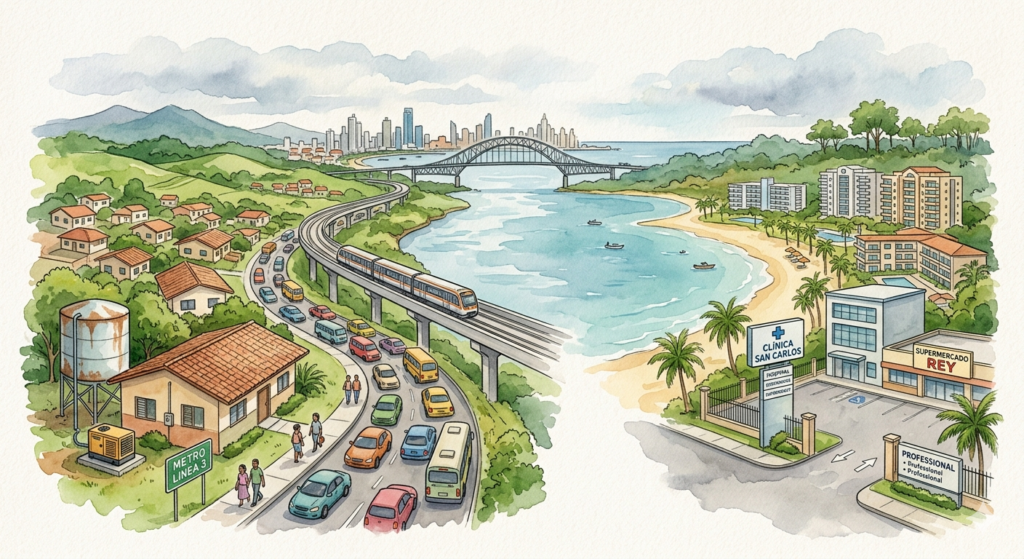
Having lived in Panama West for a year, I’ve experienced the daily grind firsthand. The region is often called a “Dormitory City”—a place where families sleep, but their economic and professional lives remain anchored in the capital. While the Metro is a game-changer for commuters, it doesn’t automatically solve the lack of local industry. Without a serious government push for economic decentralization, residents will still find themselves tied to a two-hour commute, even if that commute is now on a modern train.
The Infrastructure Gap: Beyond the Rails
The excitement over a $2.8 billion Metro project often overshadows the more mundane, yet critical, structural failures. For those considering a move to Arraiján or La Chorrera, it is vital to understand that the rapid residential growth has outpaced the utility grid.
- Utility Instability: Frequent, unprogrammed power outages and water shortages are part of daily life. The grid simply hasn’t caught up to the number of new gated communities.
- Emergency Navigation: At night, a lack of proper road signage and lighting can make navigating to a hospital or pharmacy difficult if you aren’t already intimately familiar with the backroads.
The Expat Survival Kit for the West
If you are lured by the “Boquete-style” greenery and the more affordable price tags of the West compared to Costa del Este or Santa Maria, you must go in with your eyes open. To live comfortably in Panama West in 2026, three things are non-negotiable:
- Power & Water Backup: A reliable gasoline/solar generator and a large reserve water tank (reserva de agua) are mandatory to maintain your quality of life.
- Local Intel: You must map out your emergency routes and local clinics before you need them.
- Patience for Progress: The Metro is a massive step forward, but true “city-style” living requires a local economy that hasn’t fully arrived yet.
The West offers a beautiful, more affordable lifestyle, but it currently rewards the prepared expat rather than the casual one.
The Exception: The Gold Coast (Beach Communities)
It is important to distinguish between the residential suburbs and the Panama West beach corridor (areas like Coronado, Gorgona, and Vista Mar). In these coastal sectors, the infrastructure reality is markedly different.
Because these areas have benefited from decades of heavy investment by private developers and international corporations, the urban planning and service stability are often superior to those in the suburban areas closer to the city. These “Beach Hubs” have developed their own micro-economies with high-end supermarkets, international schools, and private hospitals, allowing expats to live a full life without constantly needing to cross the bridge into the capital.
The Connectivity Gap: It is crucial to note that while the Metro Line 3 is a massive leap forward for the province, its route currently terminates in Ciudad del Futuro (Arraiján). This means the Metro does not reach the beach communities. For those living in the coastal corridor, a private vehicle remains a total necessity, as the “last mile” connectivity between the new rail system and the Gold Coast has yet to be developed.
Final Verdict
Panama West is a land of contrasts. If you are looking at the suburban areas, you are investing in a “work-in-progress” that requires personal infrastructure (water/power backups). If you are looking at the beach communities, you are entering a more established, private-sector-led environment. Both require a clear understanding of the local landscape to navigate successfully.
Editor’s Note: Success in Panama West is about being prepared. Whether you are commuting via the new Metro or enjoying the amenities of the coast, understanding the structural nuances of the province is key to a smooth transition.