
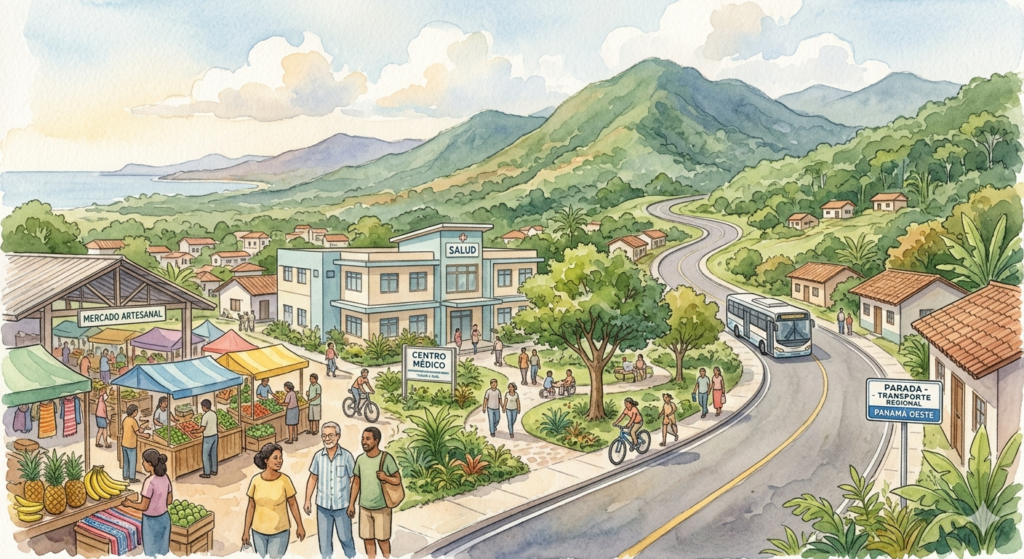
Traditionally, the expat focus has been almost exclusively on Panama City or Boquete. However, recent infrastructure investments—such as the massive $1.4 billion healthcare budget for provincial hospitals—highlight a major trend: the decentralization of quality living.
With new specialized medical facilities opening in the interior, the “medical safety net” is expanding far beyond the capital. We analyze how this shift is making areas like the Azuero Peninsula and Western Chiriquí more viable for long-term expat settlement, moving away from the “City vs. Country” binary. Is it time to look further inland for your next investment?
Healthcare Decentralization: The Game-Changer
Panama’s Ministry of Health (Minsa) allocated $1.4 billion in the 2025-2026 budget specifically for provincial hospitals, marking a 25% increase from prior years (source: Presupuesto General del Estado, MEF). This isn’t just funding—it’s action. New facilities like the Hospital Regional de Azuero in Chitré (expansion phase in 2026) and the Hospital José Domingo De Obaldía in David (Chiriquí) now operate with specialties in cardiology, oncology, and 24/7 emergencies.
For expats, this means top-tier care without hours of traffic to the capital. In Azuero, medical response times drop from 4 hours to under 1, per preliminary Minsa reports. In Western Chiriquí (Volcán, Cerro Punta), satellite clinics linked to David’s hospital cover 80% of routine needs, reducing risks for retirees or families.
Beyond Healthcare: Roads, Water, and Energy
Healthcare is the hook, but the full package transforms these regions under small-town Panama infrastructure:
- Azuero Peninsula: The upgraded Pan-American Highway ($300M works 2024-2026) connects Chitré to Pedasí in 45 minutes. Potable water projects (Ausanawater) serve 50,000 residents, and community solar energy cuts costs by 20% (ETESA data).
- Western Chiriquí: The Panama-David train (IDB-backed concession advancing) promises freight and passengers by 2027, boosting Boquete-area tourism without overcrowding. Hydro dams like Barro Blanco stabilize power, and 5G fiber reaches Volcán (ETB rollout 2025).
These upgrades slash “rural risk”: living costs 30-40% lower than Panama City (Numbeo 2026), with land at $5-10/m² vs. $20+ in Boquete.
Expat Benefits: Viable and Profitable Living
Forget the city-country binary. Azuero offers beaches, organic farms, and cultural festivals (like Feria de Azuero) with hospitals minutes away. Western Chiriquí delivers cool climate, premium coffee, and volcanoes, now backed by healthcare and logistics.
Example: An expat in Pedasí invests $150K in a farm; Airbnb ROI rises 15% with new roads and nearby health access. In Volcán, $200K properties yield returns via ecotourism, supported by medical stability.
Minimal risks: Low crime (Policía Nacional stats: 50% below Panama City), and “Pensionado Residency” programs streamline provincial paperwork.
Conclusion: Inland is the Future
This infrastructure wave makes small-town Panama infrastructure viable for serious expats. Azuero and Chiriquí aren’t temporary escapes—they’re sustainable homes. With 2029 elections looming, these projects gain momentum.
Ready to invest? Subscribe for weekly updates.