
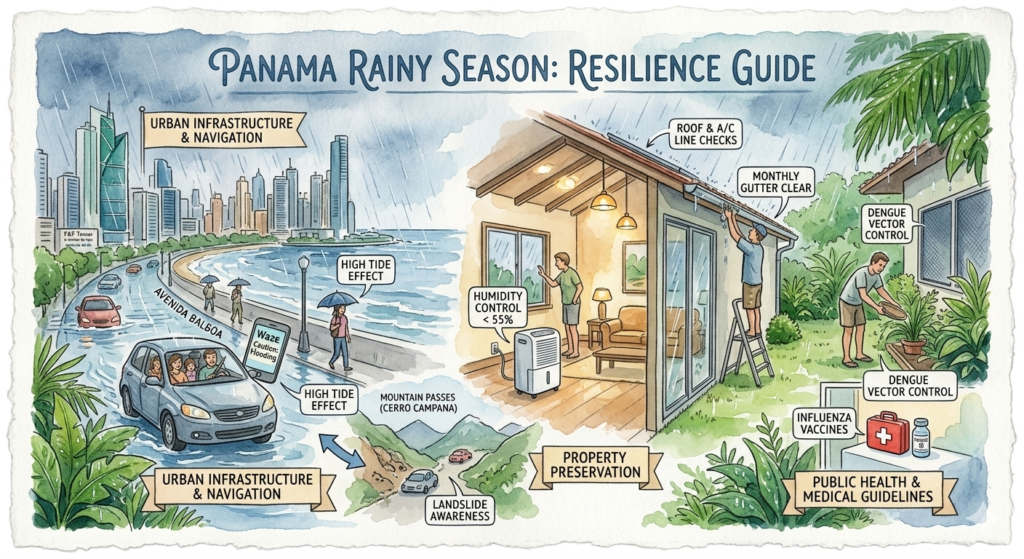
Expatriates relocating to the Isthmus quickly learn that living in Panama means adapting to a dual-climate reality. While the dry season (“verano”) offers clear skies, the official arrival of the rainy season (“invierno”) shifts the operational landscape entirely.
This guide moves past generic lifestyle advice to give you a clinical, tactical blueprint for managing risks over the six-month wet cycle. By understanding local infrastructure weaknesses, implementing structural property checks, and following strict health protocols, you can safeguard your family, your assets, and your daily runway.
1. Urban Infrastructure & Navigation: Decoding Flash Floods and Landslides
Panama City’s modern skyline often masks an antiquated drainage infrastructure. When a tropical downpour coincides with a high tide in the Bay of Panama, water has nowhere to go, resulting in near-instantaneous urban flash floods.
Critical Capital Flood Zones to Avoid
Between the hours of 2:00 PM and 5:00 PM, certain arterial corridors become highly hazardous. The severity of these floods exponentially increases when heavy rain meets a peak high tide, as the ocean restricts the outflow of the city’s drainage systems, creating immediate backups in low-lying coastal areas. Memorize and avoid these specific sectors during heavy rainfall:
- Vía Argentina (El Cangrejo): Despite recent infrastructure renovations, the lower sections near the park and the intersection with Vía España collect massive volumes of runoff water rapidly.
- Avenida Balboa: Specific pockets—particularly near Parque Urracá and the junctions leading toward the Fish Market (Mercado de Mariscos)—experience severe water accumulation that can stall standard sedans.
- Vía Tocumen and Juan Díaz: The primary transit routes near the industrial hubs and the stadium are highly prone to sudden, deep flooding.
- Calle 50: The lower intersections near San Francisco can pool water quickly, creating severe gridlock.
Tactical Navigation Protocols
- The Golden Hour Rule: If heavy rain begins in the mid-afternoon, delay your commute by 60 to 90 minutes. Panamanian downpours are intense but often brief; letting the initial surge pass allows drainage systems to catch up.
- App Reliance: Utilize Waze or Google Maps actively. The local driving community is highly efficient at reporting flooded streets and stalled vehicles in real time.
- Interior Transit Vulnerabilities: If traveling outside the capital to areas like Coronado, El Valle, or Chiriquí, remain highly alert on the Inter-American Highway. Mountainous passes—specifically the areas around Cerro Campana and the corridors through Colón—are highly susceptible to sudden landslides (deslaves) and falling debris during prolonged saturation events.
2. Property Preservation: Preventing Costly Tropical Humidity Damage
In the tropics, humidity is a structural threat. During the peak of the rainy season, relative humidity levels regularly sustain near maximum capacity, turning unmanaged interiors into breeding grounds for mold, mildew, and structural decay.
The Structural Checklist for Homeowners and Renters
To insulate your property investment from severe water and environmental degradation, execute these checks before the heavy rainfall peaks in October and November:
| Focus Area | Tactical Requirement | Operational Frequency |
| Gutters & Drains | Clear all leaf debris, sediment, and rooftop runoff blockages to prevent water backing up under your roof tiles. | Monthly |
| AC Drainage Lines | Flush out internal air conditioning drain lines to prevent internal wall leaks and mold growth behind concrete blocks. | Every 3 Months |
| Window Seals | Audit silicone seals on all outward-facing windows, especially in high-rise condos facing the ocean. | Annually |
Controlling Indoor Air Quality and Mold
- Dehumidifier Deployment: Relying solely on air conditioning is inefficient and costly. Strategically place heavy-duty compressor dehumidifiers in high-value areas like walk-in closets, home offices, and media rooms. Maintain relative indoor humidity below 55% to permanently inhibit mold spore activation.
- The “Air Flow” Myth: While opening windows during a dry season breeze is optimal, doing so during the wet season simply invites water-saturated air inside. Keep your property sealed during downpours and rely on ceiling fans to maintain internal air circulation.
3. Public Health & Medical Guidelines: Vector Control and Seasonal Wellness
The seasonal transition triggers a predictable escalation in public health vectors. Managing your personal health during the Panamanian wet season requires active prevention rather than reactive treatment.
Eradicating Dengue Vectors At Home
Dengue fever, transmitted by the Aedes aegypti mosquito, spikes aggressively during the rainy season due to the abundance of stagnant water.
- Eliminate Micro-Reservoirs: Walk your property borders weekly. Mosquitoes require only a bottle-cap amount of stagnant water to breed. Empty plant saucers, clear decorative bromeliads, audit structural drainage trays, and ensure tires or construction materials are fully covered.
- Screen Integration: Ensure all window and door screens are entirely flush and free of minor tears.
Managing Seasonal Respiratory Spikes
The onset of the rainy cycle brings a concurrent rise in seasonal influenza and respiratory illness.
- Vaccination Timelines: Ensure your family’s annual influenza vaccinations are updated. Local private hospital networks and MINSA centers distribute the specific strain formulations targeted for the current year’s regional vectors.
- Addressing Spore Allergies: Respiratory distress during the wet season is frequently tied to hidden indoor mold rather than viral infections. If you or your children experience chronic coughing, sneezing, or sinus pressure, immediately audit your property for hidden moisture entry points.
Final Thoughts: The Shift to a Resilience Mindset
Navigating the Panamanian rainy season successfully comes down to a simple framework: respecting the climate realities and acting proactively. Instead of viewing the wet season as a disruption, treat it as a structural phase that requires a shift in your operational logistics. By protecting your transit choices, securing your physical property, and maintaining strict health protocols, you ensure your life in Panama remains seamless, secure, and fully optimized year-round.