
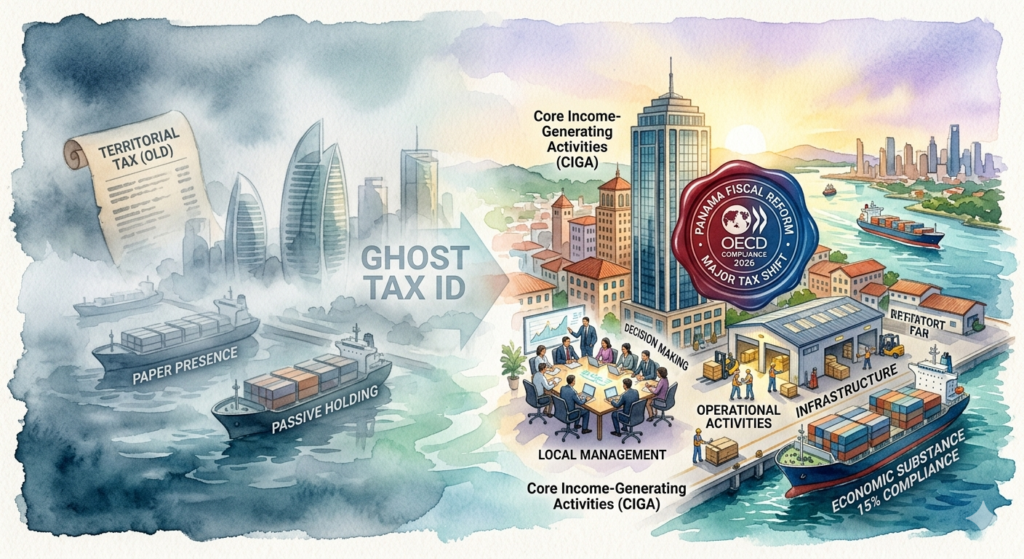
Panama has officially enacted Law No. 526 of May 28, 2026, marking the most significant reform to the national Tax Code in recent history regarding foreign-source passive income earned by entities within multinational groups. This legislation fundamentally ends the era of purely passive corporate shelters in Panama by requiring genuine economic substance for the foreign-source income exemption.
Companies that cannot demonstrate physical operations and qualified local human resources will face a flat 15% net income tax starting in fiscal year 2028.
In a major last-minute development, the Executive Branch officially sanctioned Law 531 on June 18, 2026, delaying the implementation of the highly anticipated “Total Price Law” (Ley 473 de 2025). Originally legally scheduled to take effect nationwide on June 19, 2026, the law—which mandates that all retail businesses display a single, all-inclusive final price integrating all taxes like ITBMS—has now been officially pushed back to July 1, 2027. The government granted this 12-month extension following intense pressure from private sector groups and the Chamber of Commerce, who noted that updating billing software, labels, and internal inventories represented a massive technological and logistical challenge.
What is Law No. 526?
Law No. 526 modifies and adds articles to Panama’s Fiscal Code concerning income tax and economic substance rules for specific foreign-source passive income. The law was signed by President José Raúl Mulino and published in the Official Gazette No. 30534-B on May 28, 2026.
Key Changes Introduced
| Aspect | Before Law 526 | After Law 526 |
|---|---|---|
| Foreign passive income | Fully exempt under territorial tax system | Exempt ONLY with economic substance (physical office + local staff) |
| Corporate requirements | No physical presence needed | Physical facilities + local staff REQUIRED for exemption |
| Non-compliance penalty | None | 15% flat net income tax if you DON’T have substance (FY 2027+) |
| Target entities | All entities | Multinational group entities only |
The cornerstone of Panama’s international asset protection has been its strict territorial tax framework, which kept foreign-source income entirely exempt from local taxation for decades. Law 526 changes this by mandating that legal entities incorporated locally that form part of a multinational structure must actively demonstrate genuine “economic substance” inside Panama.
Who Does Law No. 526 Apply To? Definition of Multinational Group
The law specifically targets legal entities incorporated in Panama that are part of multinational enterprise (MNE) groups. This includes:
- Investment holding companies within multinational structures
- Parent companies and subsidiaries operating across borders
- Entities earning passive income (dividends, royalties, capital gains) from foreign sources
- Companies part of groups with consolidated revenue exceeding €750 million
Types of Passive Income Affected
The economic substance requirements apply to foreign-source passive income, including:
- Dividends from foreign subsidiaries
- Royalties from intellectual property
- Capital gains from asset sales
- Interest income from foreign loans
- Rent income from foreign real estate
Economic Substance Requirements Explained: What Constitutes “Economic Substance” in Panama?
To preserve the historic foreign-source income exemption, companies must demonstrate:
1. Physical Facilities
- Office space or physical premises in Panama
- Adequate infrastructure for business operations
- Proof of location and operational capacity
2. Qualified Local Human Resources
- Employment of qualified Panama-based personnel
- Adequate number of employees relative to business activities
- Local management capable of overseeing passive asset management
3. Operating Expenditures
- Adequate operating expenditures incurred in Panama
- Real economic activity beyond mere corporate existence
- Substantive business operations, not shell company characteristics
Simplified Compliance for Investment Holding Companies
Baker McKenzie notes that standard investment holding companies may have simplified compliance pathways. These entities typically need to demonstrate:
- Proper corporate governance
- Adequate management decisions were made in Panama
- Sufficient local administrative capacity
- Compliance with corporate formalities
Tax Implications: The 15% Net Income Tax. When Does the Tax Apply?
Fiscal Year 2027 is the critical deadline. Companies failing to meet economic substance requirements will face:
- 15% flat rate on net income from foreign-source passive income
- Applied to dividends, royalties, capital gains, and interest
- No gradations or progressive rates—flat tax for non-compliance
Tax Base Calculation
The 15% tax applies to net income, meaning:
- Gross passive income minus allowable deductions
- Calculated on Panama-source tax return
- Reported starting in FY 2027 tax filings
Compliance Timeline and Critical Deadlines Immediate Actions (June 2026)
- Assess corporate structure: Determine if your entity is part of a multinational group
- Review passive income sources: Identify all foreign-source passive income streams
- Evaluate current substance: Audit existing physical presence and local staff
Before Executive Regulations Take Effect (Late 2026)
The executive regulations will provide detailed implementation rules. Key milestones:
- Q3-Q4 2026: Executive regulations expected to be published
- Before regulations take full effect: Audit and adjust corporate structures
- 2026 fiscal year: Last year without economic substance requirements for most
FY 2027 Preparation
- January 2027 onwards: Economic substance requirements fully enforceable
- 2027 tax filing: First year where non-compliance triggers 15% tax
- Ongoing: Annual compliance demonstration required
Strategic Implications for Business Owners
Why This Matters
Eduardo Gaitán, a key proponent of the law, stated: “Panama cannot continue being a refuge for paper companies”. This signals Panama’s commitment to:
- Aligning with international tax transparency standards
- Eliminating shell company usage
- Attracting genuine economic investment rather than passive sheltering
- Preventing Panama from being blacklisted for tax avoidance
Impact on Different Stakeholders
| Stakeholder | Impact |
|---|---|
| International investors | Must establish real operations or face 15% tax |
| Wealth management clients | Traditional asset protection structures need restructuring |
| Multinational corporations | Need to audit all Panama entities for substance compliance |
| Local service providers | Increased demand for office space, local staff, advisory services |
| Panama economy | Shift from passive sheltering to genuine economic activity |
How to Audit Your Corporate Structure
Step-by-Step Compliance Checklist
- Identify multinational group membership
- Are you part of a group with operations in multiple countries?
- Does your consolidated revenue exceed €750 million?
- Catalog passive income streams
- List all foreign-source dividends, royalties, and capital gains
- Calculate total passive income exposure
- Assess the current economic substance
- Do you have physical office space in Panama?
- Do you employ qualified local personnel?
- Are operating expenditures adequate for your activities?
- Gap analysis
- What’s missing to meet substance requirements?
- What investments are needed (office, staff, operations)?
- Develop a compliance roadmap
- Timeline for implementing required changes
- Budget for substance establishment
- Documentation strategy for compliance proof
- Monitor executive regulations
Common Misconceptions About Law No. 526
Myth 1: “All companies in Panama are affected”
Reality: Only entities that are part of multinational groups earning foreign-source passive income are subject to these rules. Domestic companies and purely Panama-source income operations are not affected.
Myth 2: “I can keep my shell company if I don’t earn passive income”
Reality: If your company only earns Panama-source active income, the territorial tax system still exempts foreign income automatically. The law targets foreign-source passive income specifically.
Myth 3: “I have until 2027 to figure this out”
Reality: Executive regulations take effect later in 2026, and you need time to establish physical presence and hire local staff. Delaying until 2027 means you’ll face the 15% tax immediately.
Myth 4: “Virtual offices and nominee directors count as substance”
Reality: Law 526 requires genuine economic substance—physical facilities and qualified local human resources actively managing assets. Virtual services and nominal arrangements won’t suffice.
International Context: Why Panama Made This Change
OECD and Global Tax Standards
Panama’s reform aligns with:
- OECD Base Erosion and Profit Shifting (BEPS) initiatives
- European Union tax transparency requirements
- Global minimum tax coordination efforts
- Anti-money laundering international standards
Avoiding Blacklist Status
By implementing economic substance rules, Panama:
- Demonstrates commitment to international tax cooperation
- Reduces the risk of being blacklisted by the EU or OECD
- Protects its reputation as a legitimate financial center
- Attracts genuine Business rather than regulatory arbitrage
Practical Recommendations
For Companies Currently Using Panama as a Passive Shelter
- Act immediately: Don’t wait for executive regulations
- Establish real operations: Rent office space, hire local staff
- Document everything: Keep records of operations, expenditures, and decisions
- Consider restructuring: If the substance is too costly, evaluate alternative jurisdictions
- Seek professional advice: Engage tax attorneys familiar with Law 526
For New Market Entrants
- Build substance from day one: Don’t plan to add it later
- Budget for operational costs: Include office, staff, and compliance in financial planning
- Understand the exemption: With proper substance, foreign passive income remains exempt
- Plan for the long term: This is a permanent structural change, not temporary
Frequently Asked Questions
Q: Does Law 526 affect my Panama corporation if I’m a solo entrepreneur?
A: If you’re not part of a multinational group and your income is primarily Panama-source or active foreign income, you’re likely not affected. The law targets multinational enterprise groups.
Q: Can I use a virtual office to meet substance requirements?
A: No. Law 526 requires genuine physical facilities and qualified local human resources. Virtual offices and nominee arrangements don’t constitute real economic substance.
Q: What happens if I miss the 2027 deadline?
A: Starting FY 2027, you’ll pay 15% flat tax on foreign-source passive income. There’s no grace period once the regulations take effect.
Q: Do I need to register with any new government agency?
A: Compliance will be demonstrated through your annual tax return. The tax authorities will verify economic substance during audits. Watch for executive regulations detailing specific reporting requirements.
Q: Is the 15% tax retroactive?
A: No. The tax applies starting the fiscal year 2027. Prior years remain under the old territorial tax system rules.
Conclusion
Law No. 526 represents a fundamental structural evolution in Panama’s tax regime, ending decades of purely passive corporate sheltering while preserving the territorial tax system for companies that demonstrate genuine economic substance.
The message is clear: Panama is transitioning from a jurisdiction that attracts paper companies to one that welcomes real economic activity. For multinational groups earning foreign-source passive income, the choice is straightforward:
- Establish real operations in Panama (physical office + local staff) → 0% tax on foreign passive income
- Maintain shell company without substance → 15% flat tax starting FY 2027
With executive regulations expected later in 2026, now is the critical time to audit your corporate structures and implement compliance strategies before the deadline.
Key Takeaways
- ✅ Law 526 enacted: May 28, 2026, effective FY 2027
- ✅ 15% flat tax: Applies to non-compliant multinational entities
- ✅ Economic substance required: Physical office + local qualified staff
- ✅ Target audience: Multinational group entities with foreign passive income
- ✅ Deadline: Executive regulations late 2026; tax applies FY 2027
- ✅ Exemption preserved: Foreign passive income remains exempt WITH substance
- ✅ Action needed: Audit structures now, implement changes before regulations take full effect