
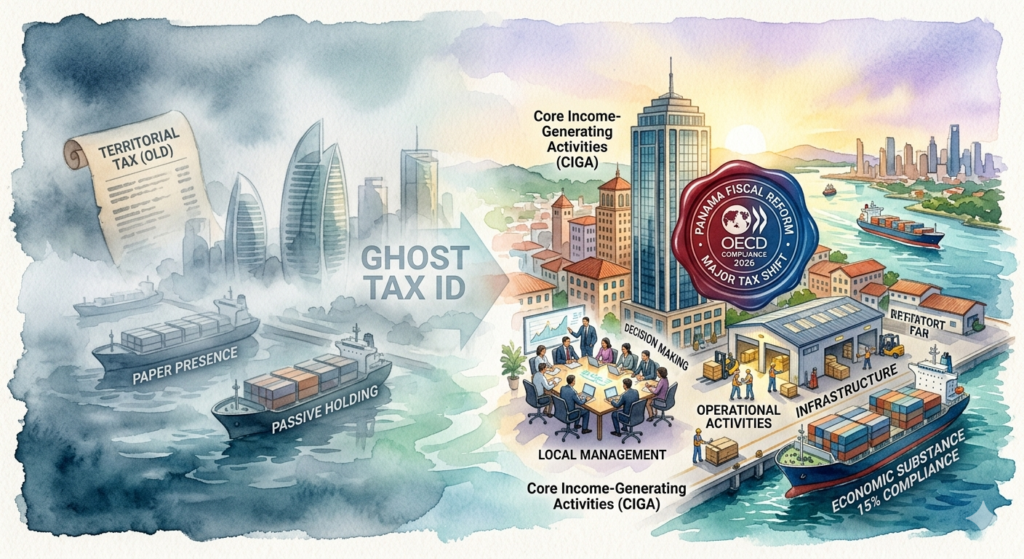
Panama is currently navigating a pivotal transformation in its fiscal architecture, marking a departure from its historical territorial tax framework toward a regime defined by economic substance. As of May 2026, the National Assembly is finalizing key legislative reforms designed to align Panama with global transparency standards, moving beyond the “paper-only” corporate presence that has long defined the country’s appeal to international entrepreneurs.
Read the full analysis of the law’s implications here
Redefining Corporate Residency and Substance
The core of this legislative shift is the mandate for “economic substance,” requiring multinational entities (MNEs) to demonstrate real, verifiable operational activity within Panamanian borders. By mandating that companies provide evidence of Core Income-Generating Activities (CIGA), management, and physical resources, the Panamanian Ministry of Economy and Finance (MEF) is directly addressing the criteria set by the OECD to remove the country from international “grey lists.”
This transition effectively ends the era of shell entities, favoring organizations that contribute to the local economy through job creation and operational infrastructure. For the Panama Fiscal Reform 2026, “substance” is no longer a suggestion—it is a mechanical requirement for tax residency.
The 15% Tax Mechanism and MNE Compliance
Central to this reform is the proposed 15% tax rate on the gross income of international entities that fail to satisfy substance or reporting requirements. This mechanism, codified through updates to the Fiscal Code, creates a strong incentive for tax residency compliance and aligns with the OECD’s Global Minimum Tax initiatives.
For high-net-worth individuals and corporate structures, this necessitates a proactive approach to tax planning:
- Entity Audit: Conduct a thorough review of corporate governance and operational presence in Panama to ensure alignment with the 2026 mandates.
- Reporting Precision: Ensure that financial disclosures accurately reflect the economic substance required by the new regulatory framework.
- Strategic Alignment: Transition from passive holding structures to active business models that qualify for lower tax exposures under the updated code.
Strategic Outlook for Investors
While these regulations represent a significant shift, they are designed to stabilize Panama’s position in the global market and improve its investment-grade credibility. As of May 2026, the government’s focus remains on maintaining a business-friendly environment while ensuring transparency.
By viewing these reforms as an opportunity to professionalize their Panamanian operations, investors can secure their status within a jurisdiction that is increasingly recognized for institutional integrity and sustainable fiscal policy. Understanding the Panama Fiscal Reform 2026 is the first step in future-proofing your international portfolio.