
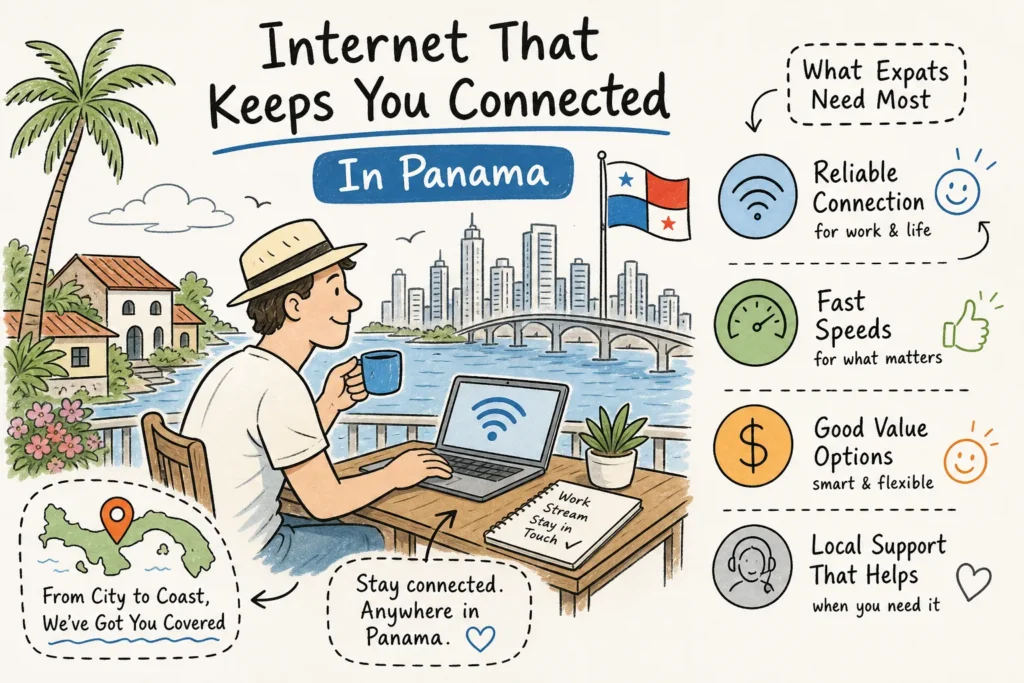
You’ve signed a lease in Panama City, packed your bags, and suddenly the realization hits: which internet provider do you call first?
When you compare internet service providers (ISPs) and their packages in Panama, the stakes are very real. Slow upload speeds, unexpected taxes, and restrictive 12-month contract exit fees are entirely avoidable—provided you do your research first. Whether you’re running a remote consulting business from Marbella, streaming in 4K from Boquete, or managing daily video calls with family back home from Coronado, picking the wrong plan costs more than just money.
The Panamanian telecommunications market has undergone massive consolidation. The provider landscape looks vastly different today than it did a few years ago. This guide cuts through the noise. We will compare the main ISPs and their packages, break down true pricing, flag hidden fees, and map real-world coverage across the expat zones that matter most.
The Market Landscape: Mergers and Infrastructure Pioneers
To make sense of broadband options in Panama, it helps to understand who actually owns the wires.
Historically, the market was shaped by two primary state and utility infrastructures. Más Móvil originated from the legacy state-owned telecom (INTEL), inheriting the nation’s foundational copper and fiber network backbones. Later, Cable & Wireless acquired a controlling stake and eventually absorbed Claro Panama, consolidating both fixed-line and mobile operations under the unified +Móvil brand.
On the other hand, Tigo evolved from Cable Onda, which started as a traditional cable TV provider. By leveraging its overhead cable footprint across utility poles, Tigo built an extensive hybrid fiber-coaxial (HFC) network.
Today, both corporate giants dominate the market with bundled packages—combining home fiber/cable, TV streaming apps, landlines, and mobile SIM plans under single billing arrangements.
However, independent high-performance operators like Wipet and InterFast have captured a loyal share of the expat and remote-worker market by offering direct, 100% symmetrical fiber-optic connections.
The Main Internet Service Providers (ISPs) in Panama
Before comparing prices, it helps to understand how the market is structured and which technologies each provider uses.
To understand Panama’s telecommunications landscape, it helps to know its roots. The market’s infrastructure was built by two legacy pioneers. Más Móvil originated as the state-owned telecom authority (INTEL), inheriting the foundational national copper and fiber backbone. Meanwhile, Tigo evolved from Cable Onda, which started as a cable TV operator and leveraged its extensive utility pole footprint to roll out broadband and telephony. Today, both giants compete fiercely by offering bundled packages (triple-play or quad-play) that combine home fiber, cable TV, bundled streaming subscriptions, landlines, and mobile SIM plans under a single bill.
Comparing Panama’s Main Internet Providers
1. +Móvil (Cable & Wireless Panama)
+Móvil is the largest full-service telecom operator in the country. They have deployed aggressive Fiber-to-the-Home (FTTH) infrastructure across major urban hubs.
- Connection Type: Pure Fiber (FTTH) in newer deployments; legacy coaxial in older areas.
- Speeds & Pricing: Entry-level fiber plans typically start around $30–$35/month for 100–200 Mbps, climbing to $45–$55/month for 300–600 Mbps, and $75+/month for Gigabit (1 Gbps) tiers.
- Key Advantage: Symmetrical bandwidth on pure fiber connections, meaning your upload speed matches your download speed—an essential feature for heavy Zoom/Teams users and cloud backups.
2. Tigo Panama (Formerly Cable Onda)
Tigo remains the dominant residential cable provider across Panama City, West Panama, Coronado, and major regional cities like David.
- Connection Type: Hybrid Fiber-Coaxial (HFC) and expanding FTTH.
- Speeds & Pricing: Competitive promotional packages run from $35/month for 150 Mbps up to $50–$65/month for 300–600 Mbps.
- Key Advantage: Deep residential coverage in high-rise condos (PHs) and attractive TV/streaming bundle combinations.
- Note on Uploads: On coaxial lines, Tigo often caps upload speeds between 15 Mbps and 30 Mbps regardless of high download tiers.
3. Wipet & Independent Symmetrical Fiber
Wipet is a top choice among remote professionals residing in Panama City’s high-density neighborhoods (Costa del Este, San Francisco, Punta Pacífica) and select beach communities.
- Connection Type: 100% Symmetrical Fiber Optic.
- Speeds & Pricing: Plans range from $30/month up to 300 Mbps.
- Key Advantage: Dedicated 1:1 upload ratios, low ping/latency, human-centered VIP customer support, and direct English-language assistance—making it highly rated for remote work and gaming.
4. Starlink (Satellite)
For expats settling in rural Boquete, the highlands of Volcán, the Azuero Peninsula, or the islands of Bocas del Toro, Starlink is no longer a luxury backup; it is the primary broadband solution.
- Hardware & Pricing: Dish hardware costs approximately $250–$380, with unlimited residential monthly service priced at $52/month.
- Performance: Delivers real-world speeds between 100 Mbps and 220 Mbps with low latency, bypassing the patchy legacy copper wiring of rural zones.
Compare Panama Internet Packages: Which ISP Offers the Best Deal?
| Plan Tier | Typical Download / Upload Speed | Average Monthly Cost (USD) | Connection Type | Best Household Match |
|---|---|---|---|---|
| Entry Tier | 100 – 150 Mbps (Asymmetrical) | $30 – $38 | Coaxial / Fiber | Retirees, single users, light streaming |
| Work-From-Home (Value) | 300 – 400 Mbps (Symmetrical FTTH) | $40 – $52 | Pure Fiber (Más Móvil / Wipet) | Remote workers, daily video conferencing, 4K streaming |
| Power User Tier | 600 Mbps | $50 – $65 | Fiber / Coaxial | Multi-device family households, large file transfers |
| Gigabit Tier | 1,000 Mbps (1 Gbps) | $75 – $110 | Pure Fiber | Tech professionals, home offices with concurrent power users |
Pro Tip (Avoid the “Loyalty Penalty”): Panamanian ISPs frequently launch aggressive promotions offering higher speeds for lower rates to attract new subscribers. Long-term subscribers often end up paying more for legacy, slower tiers. Set a reminder every 12 months to review your provider’s current public promos and request an updated plan rate.
Summary Checklist Before You Sign
- Verify Full Physical Address: Check your exact building name and street address on the ISP’s coverage system—block-by-block differences are common.
- Ask the Landlord for a Speedtest: Request a current screenshot showing both download and upload speeds from the actual rental unit.
- Calculate Total True Cost: Add the base plan + $5 modem fee (if applicable) + 7% ITBMS tax to understand your real monthly expense.
- Prepare Sign-Up Documents: Foreigners only need a valid passport and a copy of their signed lease agreement (or utility bill) to open an account—a Panamanian cédula is not required.
For comprehensive neighborhood breakdowns, lifestyle guides, and smart spending strategies across the country, explore our full resources at Panama Life Hub.
Hidden Fees, Taxes, and Contract Rules
- ITBMS Tax (7%): Telecom prices advertised on billboards or websites usually exclude Panama’s 7% ITBMS sales tax. A plan listed at $50/month will actually total $53.50/month.
- Installation & Modem Fees: While standard setup fees range between $50 and $100, almost all ISPs will waive this fee if you commit to a minimum contract. Equipment (Wi-Fi router) is typically included or rented for a nominal fee ($5/month).
- Contract Durations & Early Termination Fees (ETF): Most promotional rates require a 12-month commitment. If you break a lease early or leave the country before the contract expires, cancellation penalties can range from $100 to $200. If you are on a short-term trial stay, inquire about month-to-month plans or clarify ETF terms in writing before signing.
- While promotional rates from big legacy ISPs often come bundled with a 12-month loyalty agreement in exchange for free installation, a 12-month contract is not mandatory in Panama. Expats staying short-term can opt for month-to-month arrangements with independent ISPs (like Wipet), use Starlink, or simply pay an upfront installation fee with traditional providers to bypass long-term commitments.
Internet Reliability by Expat Region
Local Coverage & Service Stability: What to Expect
Coverage quality is highly localized. Both major providers have specific ‘dead zones’ or neighborhoods where their performance drops noticeably; therefore, choosing between Tigo and Más Móvil depends entirely on which network performs better at your specific street address. Furthermore, internet stability across Panama can fluctuate. While peak speeds are impressive, maintaining maximum bandwidth 24/7 without minor latency spikes or weather-related hiccups is rare—making power backups and secondary connections essential for critical remote work.
Panama City (Paitilla, Punta Pacífica, Costa del Este, San Francisco, El Cangrejo)
- Status: Excellent (4.5/5)
- Primary Providers: Tigo, Más Móvil, Wipet, InterFast.
- Reality: High-rise residential towers usually have pre-installed fiber infrastructure. Real-world speeds frequently exceed 300 Mbps. Older areas like Casco Viejo may have structural cabling limitations, making fixed-wireless or mobile hotspots necessary in select historical buildings.
Coronado & The Pacific Beaches (Gorgona, San Carlos, Bijao)
- Status: Good to Moderate (3.5/5)
- Primary Providers: Tigo, Más Móvil, Wipet, Starlink.
- Reality: Gated communities along the coast generally have reliable cable or fiber. However, power outages during the rainy season can disrupt local nodes. A UPS (Uninterruptible Power Supply) battery backup for your router is mandatory for remote workers here.
Chiriquí Province (David & Boquete)
- Status: Moderate to High (3.8/5)
- Primary Providers: Más Móvil, Tigo, Starlink.
- Reality: David has solid fiber infrastructure throughout the city. Central Boquete has good fiber availability, but properties situated up the mountain slopes (e.g., Alto Boquete, Jaramillo) often lack physical lines. Starlink has become the go-to standard for mountain properties.
Bocas del Toro (Isla Colón, Carenero, Bastimentos)
- Status: Variable / Off-Grid Focus (2.5/5)
- Primary Providers: Starlink, Mobile Hotspots (Tigo/Más Móvil), Local Micro-ISPs.
- Reality: Traditional landline infrastructure is limited. While mainland towns have basic coverage, island living relies heavily on Starlink or cellular routers. If you plan to run Zoom calls from Bocas, verify that your rental property has a dedicated Starlink installation or a clear line of sight to mount one.
Practical Remote Work Checklist: Staying Connected
- Test Before You Sign a Lease: Never rely on general neighborhood claims. Ask the landlord for a current Speedtest.net screenshot showing both download/upload speeds and ping/latency.
- Invest in a UPS (Uninterruptible Power Supply): Power fluctuations occur across Panama during heavy thunderstorms. A $50–$80 UPS battery backup keeps your modem and Wi-Fi running during brief outages.
- Set Up a Dual-SIM Mobile Backup: Keep a local prepaid or postpaid SIM card on your smartphone with tethering capabilities. If your primary fiber line drops during a work meeting, switching to a mobile hotspot takes less than a minute.
- Use Coworking Spaces as Fallbacks: Panama City boasts modern coworking hubs in Obarrio, Punta Pacífica, and Costa del Este, while Boquete and Selina locations in Bocas/Venao offer backup workspaces equipped with redundant generator power and high-speed lines.