
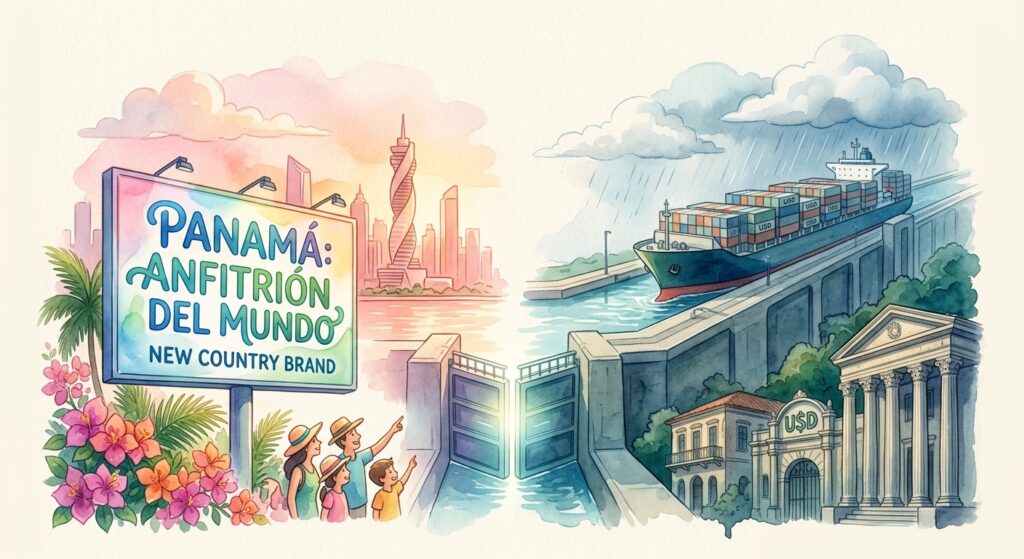
Whenever a new administration takes office in Panama, a familiar ritual unfolds in the press. Glossy marketing presentations, grand speeches at convention centers, and multimillion-dollar contracts signal the launch of Panama’s latest “Marca País” (Country Brand).
The newest campaign—unveiled on September 3, 2026, under the banner “Panamá, Anfitrión del Mundo”—promises the world: a unified strategy to boost eco-tourism, attract direct foreign investment (FDI), and position the Isthmus as Central America’s primary commercial, real estate, and logistics hub.
To the international reader or the newly arrived expat, these announcements sound like a massive vote of confidence in the country’s future. But if you have lived in Panama long enough to witness a few presidential handovers, you know that the reality behind these campaigns is far more complex—and considerably more political.
Understanding how Panama actually operates requires looking past the branding slogans and examining the political cycles, institutional habits, and real economic engines that keep this country standing.
The 5-Year Rebranding Novel: Why Tourism Plans Lack Continuity
To understand why local business owners and seasoned residents react to these announcements with a nod of healthy skepticism, one must look at Panama’s political history.
Panama does not suffer from a lack of potential, natural beauty, or strategic location. Historically, it lacks state-level policy continuity.
In an ideal framework, a national tourism and investment brand is a long-term asset that spans decades, regardless of which political party holds power. In Panama, however, every five-year presidential cycle brings a near-total reset:
- Political Patronage: A change in government almost always means a complete shift in advertising agencies, creative teams, and public relations firms. Previous campaigns—regardless of their international success or ROI—are routinely discarded.
- Benefiting Campaign Donors: Millions of dollars in public marketing budgets are frequently redirected to new private-sector contractors and campaign backers who were excluded during the prior administration.
- Lack of Institutional Memory: Tourism strategies are rarely allowed to mature. Instead of building upon established international awareness, the country continuously pays to introduce “new” slogans to the global market every half-decade.
As a result, Panama’s official tourism infrastructure often feels like a series of unfinished chapters rather than a cohesive story. While private operators, boutique hotels, and regional tour guides work tirelessly to build world-class experiences, public sector promotion remains tied to the political calendar.
Where the Real Power Lies: What Actually Anchors Panama’s Economy
Here is the good news for expats, retirees, and foreign investors: Panama’s structural stability has never depended on a marketing campaign.
If Panama’s economic survival relied on government-sponsored tourism strategies, the nation would face perpetual volatility. Fortunately, the true pillars of Panama’s economy operate on a completely different level—insulated from five-year advertising budgets and political rebrandings.
For foreign residents evaluating the long-term safety of their investments, health, and lifestyle in Panama, the focus should always remain on three core pillars:
1. The Panama Canal System
The Panama Canal is not just a waterway; it is the financial backbone of the state. Generating billions in direct revenues annually, the Canal funds public infrastructure, services, and sovereign obligations. With historic leadership milestones—such as Ilya Espino de Marotta taking office as Administrator—and ongoing long-term investments in water management (like the Indio River reservoir project), the Canal guarantees macroeconomic resilience that no marketing slogan could ever replicate.
2. The International Banking Center & Dollarization
Panama’s financial sector comprises over 60 domestic and international banks operating under a robust, dollarized monetary system. The absence of a central bank printing local currency shields residents from hyperinflation and currency devaluation risks that plague other destinations in the region.
3. The Logistics and Service Platform
From Tocumen International Airport (the “Hub of the Americas”) to our deep-water container ports and free trade zones, Panama’s geographic position ensures a continuous flow of global commerce. These structural assets generate steady non-tax revenues regardless of how many tourists arrive in a given quarter.
The Expat Takeaway: Pragmatism Over Headlines
Does a new Country Brand help Panama? On the surface, yes. Fresh promotional campaigns do bring short-term international media visibility, attract business conferences to the Panama Convention Center, and assist airlines in filling seats.
However, as an expat living here or considering a long-term move, it is crucial to separate governmental marketing from macroeconomic truth:
- Do not base real estate or business investments on government promotional promises. Invest in proven regions (like Panama City’s prime urban sectors, Boquete, or established beach communities) that thrive on organic demand, reliable services, and strong private infrastructure—not on speculative public tourism projections.
- Watch the Canal and Banking news, not the advertising budgets. The operational efficiency of the Canal, local interest rate adjustments, and tax compliance regulations will impact your daily wallet far more than any regional tourism campaign.
- Appreciate the permanence of Panama’s real assets. Governments change, slogans fade, and ad agencies rotate. But the canal, the dollar, the geographic location, and the warm hospitality of the Panamanian people remain untouched.
Panama remains one of the safest, most dynamic, and financially stable places in Latin America to live, work, and retire. Just remember to look past the billboard, enjoy the local lifestyle, and keep your eye on the numbers that actually matter.