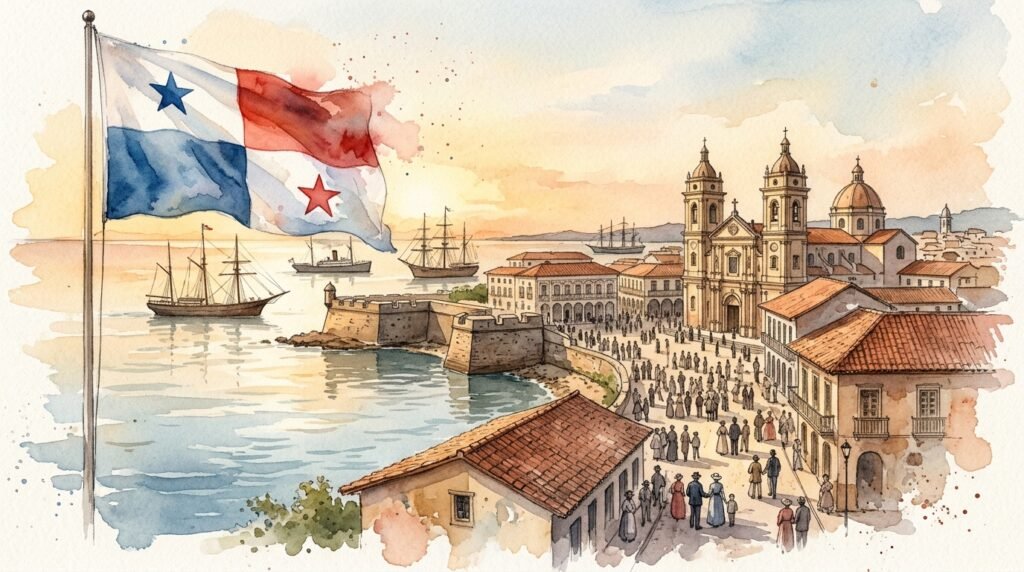
On November 3, 1903, Panama formally declared its separation from Colombia and established the Republic of Panama. For expats living in Panama, the date is more than a national holiday: it explains the country’s strategic position, its dollar-based economy, its civic calendar, and the great national pride visible throughout Mes de la Patria.
Why November 3 matters in Panama
Panamanians celebrate November 3 as Separation Day, the date on which the Isthmus separated from Colombia and a provisional government was formed. The United States recognized the new republic on November 6, 1903, helping consolidate Panama’s emergence as a sovereign state.
It is important to use the term “separation from Colombia” rather than “independence from Colombia.” Panama had already declared independence from Spain on November 28, 1821; the 1903 event marked Panama’s separation from Colombia and the creation of the modern Republic of Panama.
The historical context of 1903
Panama’s separation occurred after decades of political tension, including Colombia’s Thousand Days’ War and frustration over economic neglect and unstable governance on the Isthmus. Panamanian leaders also saw an opportunity to secure the construction of an interoceanic canal, a project with enormous commercial and geopolitical value.
The United States had a direct interest in building the Panama Canal. After Colombia rejected the Herrán–Hay Treaty, events moved quickly toward separation, and the new republic became central to one of the most consequential infrastructure projects in modern history.
A quick timeline
- November 3, 1903: Panama declares separation from Colombia and establishes a provisional government.
- November 4, 1903: Panama’s separation is formally proclaimed in Panama City.
- November 6, 1903: The United States recognizes the Republic of Panama.
- 1904: Panama introduces the balboa, named after Spanish explorer Vasco Núñez de Balboa.
- 1914: The Panama Canal opens, transforming global maritime trade and cementing Panama’s logistical importance.
How separation shaped Panama’s economy
The new republic inherited a strategic location between the Atlantic and Pacific oceans. That geography made the Panama Canal possible and positioned the country as a global hub for shipping, logistics, banking, trade, and international services.
For expats, this history helps explain why Panama is unusually internationally oriented. Its economy is built around the Canal, the Colón Free Zone, maritime services, tourism, and cross-border commerce—not merely domestic consumption.
Why Panama uses U.S. dollars
Panama’s monetary system is closely connected to its post-separation development. The Panamanian balboa was introduced in 1904, shortly after separation, and has been pegged one-to-one with the U.S. dollar. In practice, the U.S. dollar circulates as legal tender alongside the balboa, making everyday transactions straightforward for many expats.
This dollarized economy reduces currency-conversion friction for U.S.-linked income, retirement funds, and international business. However, it does not mean Panama has no monetary identity: the balboa remains Panama’s national currency unit and appears in official accounting and coins.
Panama Canal and geopolitical standing
The separation of 1903 ultimately enabled the construction of the Panama Canal, which opened in 1914 and reshaped global trade by connecting the Atlantic and Pacific. The Canal remains a defining symbol of Panamanian sovereignty and a major driver of national revenue and international relevance.
For resident expats, Panama’s geopolitical position translates into practical advantages: strong air connectivity, international banking services, a large logistics sector, and a business environment accustomed to foreign investors and multinational companies.
What expats should know about Mes de la Patria
November is Mes de la Patria, Panama’s month of national celebrations. It commemorates the events that produced an independent nation, including the separation from Colombia and the earlier independence from Spain.
The most visible celebrations occur in early November:
- November 2: Day of the Deceased, a day of remembrance.
- November 3: Separation Day, marking Panama’s separation from Colombia in 1903.
- November 4: Flag Day, honoring Panama’s national symbols.
- November 5: Colon Day, commemorating the consolidation of separation in Colón.
- November 10: Primer Grito de Independencia, remembering the first call for independence from Spain.
- November 28: Independence from Spain, commemorating the 1821 declaration.
Expect school parades, civic ceremonies, marching bands, traditional dress, road closures, and increased domestic travel. Expats should plan banking, government appointments, deliveries, and intercity travel around these dates.
How history influences modern law and real estate
Panama’s separation created a new republic with its own legal institutions, civil code traditions, and commercial framework. While Panama’s legal system draws on civil-law traditions, its modern commercial environment is also shaped by its role as an international trade and logistics center.
For real estate buyers and investors, the historical context matters in three practical ways:
- Foreign ownership: Panama generally allows foreigners to own titled property in their own name, though due diligence remains essential.
- Dollar pricing: Real estate transactions are commonly quoted and settled in U.S. dollars, simplifying comparisons for expat buyers.
- Canal-centered development: Panama’s logistics economy supports demand in Panama City, Colon, beach communities, and areas connected to trade, tourism, and retirement migration.
This does not make every property a good investment. Buyers should still verify title, permits, homeowners’ association rules, taxes, and the legal status of any land before signing.
Practical meaning for daily expat life
Understanding Panama’s separation from Colombia helps expats interpret the country beyond stereotypes of beaches and tax incentives. November 3 represents national self-determination, a deliberate break from Colombian rule, and the beginning of a state whose identity is tied to the Isthmus, the Canal, and international commerce.
In daily life, that history appears in patriotic school events, public holidays, national symbols, museum narratives, and the pride Panamanians take in their country’s unique geographic role. Respecting these traditions is one of the simplest ways for expats to integrate more thoughtfully into local communities.
Frequently asked questions
What happened on November 3, 1903?
Panama declared its separation from Colombia and created a provisional government for the new Republic of Panama. The United States recognized Panama three days later.
Is November 3 Panama’s independence day?
Not exactly. November 3 is Separation Day, when Panama separated from Colombia. Panama celebrates independence from Spain on November 28.
Why does Panama use U.S. dollars?
The U.S. dollar has circulated alongside the Panamanian balboa since the early republican period. The balboa is pegged at one-to-one with the dollar, and the dollar is legal tender in Panama.binal.ac+1
How does November 3 affect expats?
It is a major public holiday within Mes de la Patria. Expats may encounter parades, closures, ceremonial events, busy roads, and altered business schedules during early November.