On November 28, 1821, Panama peacefully separated from Spanish rule and joined the Republic of Colombia. For today’s expatriates, that date is more than a national holiday: it marks the beginning of a commercial tradition that still shapes Panama’s open economy, international outlook, and appeal to foreign residents.
A Practical Independence
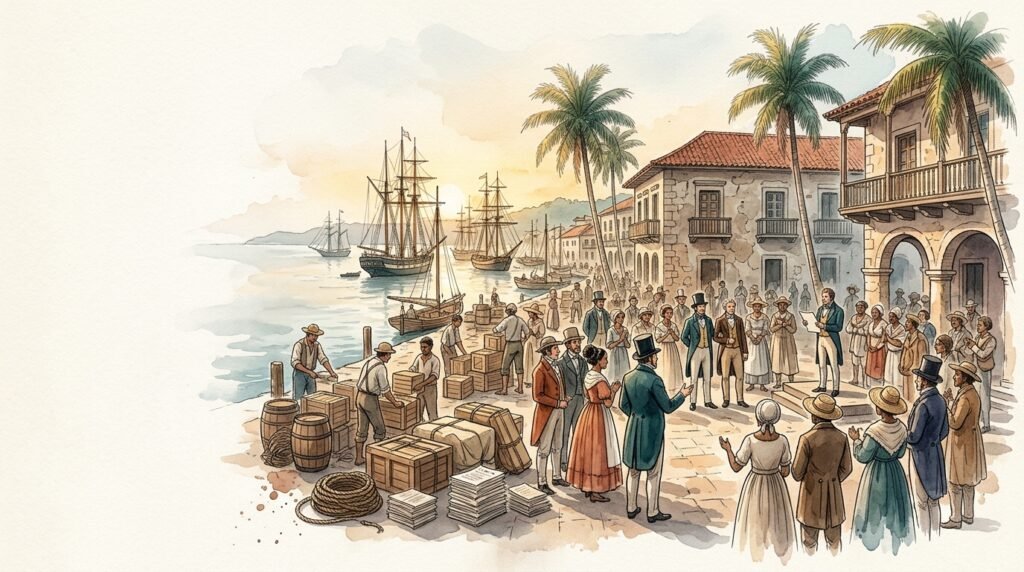
Panama’s independence from Spain was notably orderly. After the Grito de La Villa de Los Santos on November 10, 1821, local leaders in Panama City convened an open town meeting and declared the Isthmus independent from Spain on November 28. Merchants, civic authorities, landowners, and other local elites supported the move to protect trade, property, and stability during a period of upheaval across Spanish America.
Unlike many independence struggles in the region, the transition involved little violence. Panama did not declare itself a standalone nation at that moment; instead, it voluntarily joined Gran Colombia, the republic led by Simón Bolívar that included present-day Colombia, Venezuela, and Ecuador.
That decision reflected a very Panamanian calculation: preserve the Isthmus’s role as a crossroads for people, goods, and capital.
Why Panama Separated from Spain
By 1821, Spanish rule in the Americas was weakening. Napoleon’s invasion of Spain had destabilized the monarchy, local juntas had emerged across the empire, and independence movements were advancing from Mexico to South America. Panama was not isolated from these changes: its elites followed events in Spain, Gran Colombia, and neighboring territories closely.
For Panama, however, the decisive issue was economic. The Isthmus had long depended on transit trade: goods moving between the Pacific and Caribbean, commercial activity in Panama City, and the historic trade fairs at Portobelo. When Spanish imperial trade declined, and conflict disrupted shipping routes, local merchants and landowners saw their livelihoods threatened.
There was also a political calculation. Panama’s commercial elite wanted to avoid being drawn into prolonged warfare and to preserve order, property rights, and access to international markets. Independence from Spain offered a way to do that without immediately isolating Panama from the wider region.
How Independence Happened
The process unfolded in two key moments.
On November 10, 1821, residents and local leaders in La Villa de Los Santos issued the Grito de La Villa de Los Santos, an early call for independence from Spain. It signaled that support for separation was spreading beyond Panama City and gave the movement political momentum.
On November 28, 1821, Panama City held an open town meeting, or cabildo abierto. With Spanish military authority already weakened by defections and the collapse of royalist control, the assembly declared the Isthmus “free and independent” from the Spanish Crown. The declaration was signed by civic and military leaders, merchants, and other prominent residents.
The transition was largely peaceful because the main actors shared a practical objective: avoid violence, protect commerce, and secure a stable political future. Rather than forming a separate republic, Panama chose to join Gran Colombia, Bolívar’s union of former Spanish territories. That choice reflected both ideological sympathy with the independence movement and a belief that union would protect Panama’s trade routes and regional position.
Why the Date Still Matters
November 28 is therefore not simply the anniversary of a declaration. It represents a local decision to take control of Panama’s future at a moment when the old imperial system was failing.
For expatriates, the key point is that Panama’s independence was driven by people who understood the value of stability, trade, and international connection. Those priorities did not disappear in 1821. They became part of the country’s institutional and commercial culture, influencing the later development of the railroad, the Panama Canal, the Colón Free Zone, international banking, and today’s logistics and professional-services economy.
Commerce Came First
Panama’s commercial identity long preceded independence. During the colonial era, Portobelo served as a major trade hub between Spain and its South American territories, while Panama City connected the Isthmus’s Pacific and Caribbean sides. The territory’s value was never simply geographic; it was strategic.
By 1821, merchants and local leaders understood that political disruption could interrupt shipping, customs revenue, and the movement of goods across the Isthmus. Their priority was to secure a stable framework that would keep Panama connected to international markets. Historical accounts describe the independence movement as closely tied to these economic and commercial interests.
In other words, Panama’s founders were not only pursuing political freedom. They were protecting a business model built on transit, trade, and openness to the world.
The Roots of an Open Economy
That early commercial logic helps explain several features of modern Panama that expatriates often notice quickly:
- A service-centered economy: Banking, logistics, legal services, insurance, tourism, and professional services play an outsized role.
- International orientation: Panama’s location made it a natural meeting point for Atlantic and Pacific commerce long before the Canal existed.
- Use of the U.S. dollar: The balboa is Panama’s official currency, but the U.S. dollar circulates as legal tender, supporting everyday transactions and cross-border business.
- A culture of connectivity: From colonial trade fairs to the Panama Canal, the country’s history has rewarded people and institutions that can move goods, money, and ideas efficiently.
None of this means Panama’s history was simple or uniformly prosperous. Independence from Spain did not immediately produce broad prosperity, and Panama remained part of Colombia for another 82 years before separating in 1903. But the commercial priorities established in 1821 became a durable part of the national story.
What It Means for Expats
For expatriates, this history offers useful context. Panama is not merely a country that happens to welcome foreign residents; it has spent centuries positioning itself as a place where international connections matter.
If you are an entrepreneur, that helps explain why Panama has developed a business environment oriented toward trade, regional headquarters, logistics, and financial services. If you are a retiree, it helps explain the country’s familiarity with foreign residents, international banking, travel connections, and a service economy designed around convenience. And if you own property, it helps explain why location, access, infrastructure, and cross-border mobility remain central to Panama’s real estate appeal.
The lesson is not that every opportunity in Panama is easy or risk-free. It is that the country’s historical DNA favors openness, intermediation, and practical problem-solving—qualities that continue to influence how business and daily life work today.
A Legacy Still Visible
Every November 28, Panama commemorates the day it broke from Spain. But the deeper legacy is not only political independence. It is the decision by local leaders to keep the Isthmus open to the world.
For expatriates building a life, business, or investment in Panama, that legacy is visible in the country’s ports, free zone, banking sector, international airport, professional services, and multicultural population. Panama’s 1821 independence did not create the modern commercial hub overnight, but it reinforced a direction the country has followed ever since: connect, trade, serve, and remain open for business.
Closing Thought
Understanding November 28 helps expatriates see Panama less as an isolated market and more as a historic bridge between regions. That perspective makes the country’s modern economy—and its opportunities—much easier to understand.