
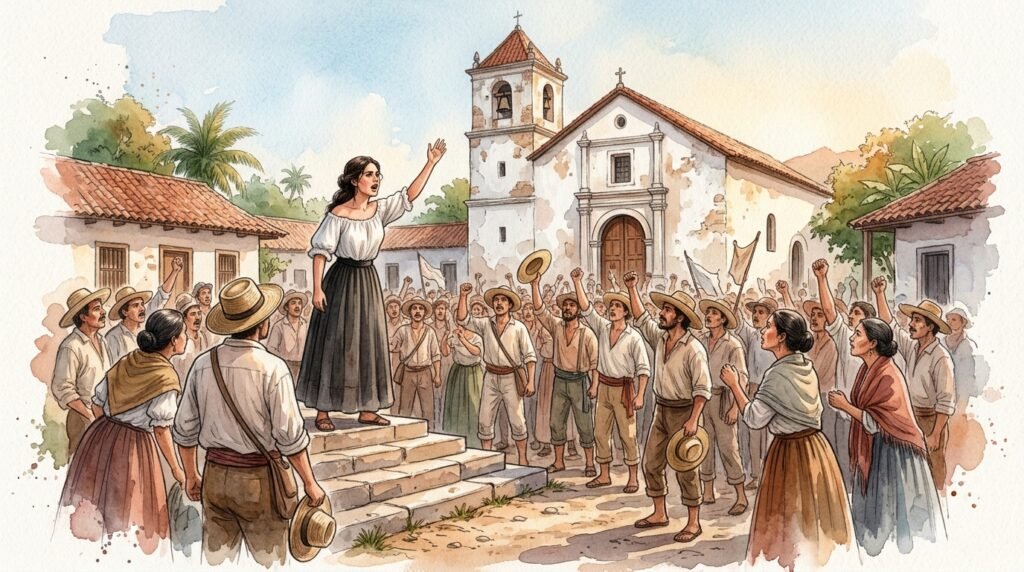
On November 10, 1821, residents of La Villa de Los Santos rose against Spanish colonial authority in what Panama remembers as the Primer Grito de Independencia—the First Cry of Independence. For foreign residents, especially those living beyond Panama City, understanding this date offers a meaningful window into the values that still influence life in the interior provinces: local pride, civic participation, cultural identity, and community solidarity.
What Happened on November 10
The uprising began in La Villa de Los Santos, in today’s province of Los Santos, when local patriots organized by Segundo de Villarreal challenged Spanish colonial control. The movement reflected growing frustration with colonial restrictions, abuses of authority, and economic hardship affecting much of the isthmus.
The events of November 10 did not immediately create an independent nation. Instead, they ignited a broader emancipation process that culminated on November 28, 1821, when Panama formally declared independence from Spain through a Cabildo Abierto.
| Date | Event | Why it matters |
|---|---|---|
| November 10, 1821 | The Primer Grito in La Villa de Los Santos | The first major popular uprising against Spanish rule in Panama. |
| November 1821 | Other communities joined the independence movement | Towns including Penonomé, Natá de los Caballeros, Santiago de Veraguas, and Portobelo were inspired by the action. |
| November 28, 1821 | Panama declared independence from Spain | The broader movement begun by the November 10 uprising reached its formal conclusion. |
Rufina Alfaro: History and Symbol
Rufina Alfaro is closely associated with the Primer Grito and is traditionally credited with helping patriots obtain information about the Spanish barracks and with proclaiming, “¡Viva la libertad!”—“Long live freedom!” Her story has made her an enduring symbol of courage, popular participation, and women’s role in Panama’s independence narrative.
It is important to distinguish history from legend. Academic research has noted that contemporary documentation does not clearly confirm Alfaro’s participation in the events, and some historians regard her as a semi-legendary figure whose story was popularized in the twentieth century.
That distinction does not diminish her cultural importance. For many Panamanians, Rufina Alfaro represents the collective courage of ordinary people in La Villa de Los Santos and the interior provinces—people whose actions helped set Panama on the path to sovereignty.
The Spirit of Autonomy
The central idea behind November 10 is not merely rebellion against colonial rule. It is a deeper tradition of regional autonomy: the belief that local communities should have a voice in decisions that affect their land, livelihoods, families, and future.
In the interior provinces, this legacy remains visible in civic celebrations, local traditions, community organizations, and a strong attachment to place. November 10 is a national holiday, and La Villa de Los Santos remains the symbolic heart of the commemoration.
For expatriates, this history helps explain why many residents of Azuero, Veraguas, Cocle, Herrera, and other interior regions value direct relationships, local reputation, and community involvement. These are not simply “small-town customs”; they reflect a long-standing culture in which neighbors, families, and local institutions play an important role in daily life.
Why It Matters for Resident Expats
Foreign residents who understand the meaning of November 10 are better prepared to engage respectfully and successfully with Panamanian communities. The date is a reminder that Panama’s identity is not defined only by Panama City, the Panama Canal, or international business—it is also shaped by provincial history, regional pride, and grassroots resilience.
Community engagement
Participating thoughtfully in local life can open doors that paperwork alone cannot. Attending civic events, supporting local businesses, learning about regional traditions, and building relationships with neighbors are practical ways to become part of a community rather than merely living beside it.
Property ownership dynamics
The spirit of autonomy also has practical relevance for property ownership. In many interior communities, trust, local knowledge, and long-term relationships influence how land, homes, and development projects are perceived. Foreign buyers who approach a community with patience, transparency, and respect for local customs often find the process more constructive.
This does not replace professional legal due diligence. It means that a successful property purchase or relocation strategy should consider both formal requirements and the human context: who lives nearby, what the community values, and how a new resident can contribute positively over time.
Cultural integration
November 10 invites expats to see Panama not as a backdrop for retirement or investment, but as a country with a living history. Understanding the Primer Grito helps newcomers interpret the pride many Panamanians feel toward their provinces, their traditions, and their role in the nation’s story.
Lessons for Newcomers
- Respect local history: November 10 is more than a holiday; it represents a foundational moment in Panama’s path to independence.
- Value community relationships: In the interior, trust and participation often matter as much as transactions.
- Learn before assuming: Panama’s regions have distinct identities, and the history of Los Santos offers important context for understanding them.
- Engage with humility: New residents are most welcome when they listen, contribute, and respect local traditions.
- Think long term: Property ownership and community integration both reward patience, consistency, and genuine local involvement.
A Living Legacy
The Primer Grito of November 10, 1821, remains relevant because its core message has endured: ordinary people, acting together, can shape the direction of their community and country. For resident expatriates, embracing that spirit does not require adopting a political cause; it means recognizing that belonging in Panama is built through respect, participation, and a sincere connection to local life.
For anyone considering a home, investment, or long-term life in Panama’s interior, November 10 offers a valuable lesson: the most meaningful relationships—and the most secure sense of belonging—are built not only on contracts and credentials, but on community, character, and shared respect.