
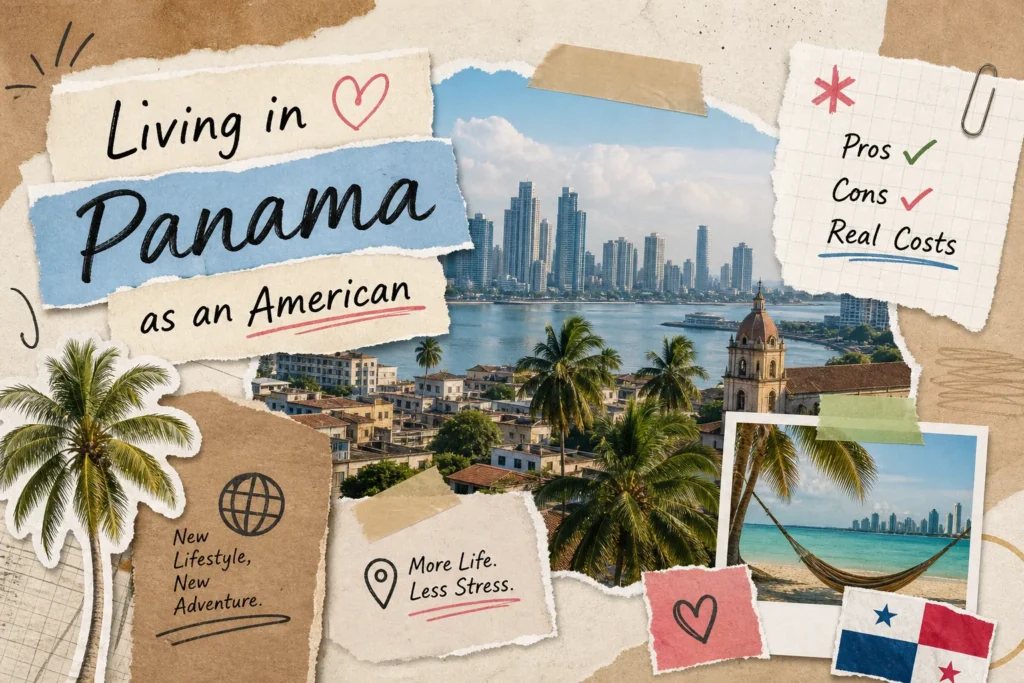
Living in Panama as an American means making a genuinely informed trade-off, and for many people, it pays off. The economy runs on U.S. dollars, flights from Miami typically take around two and a half to three hours, and Panama cost of living in 2026 is significantly lower than comparable U.S. cities: a single expat in Panama City commonly spends $1,500 to $2,500 per month, while smaller cities like David or Chitré can run $800 to $1,500 for the same quality of life. That’s the honest pull, and it’s real.
But Panama isn’t a perfect tropical utopia, and pretending otherwise does a disservice to anyone seriously considering the move. The bureaucracy is genuinely slow, Panama City’s tropical climate brings hot, humid conditions for much of the year, and opening a bank account as an American involves paperwork that will test your patience. The difference between a smooth relocation and a frustrating one usually comes down to knowing what you’re walking into before you land. That’s the purpose of resources like Panama Life Hub, Your Expert Guide, which covers the country from the inside out, neighborhood by neighborhood, with on-the-ground detail built from people who live here year-round. This article gives you the framework: visas, real costs, healthcare, taxes, and where to actually live.
Living in Panama as an American: The Cultural Rules You Need to Respect
You can hire the best attorney and clear banking compliance, but if you don’t understand the historical relationship between Panama and the U.S., your integration will fail. Here is a brief analysis of the 3 historical turning points you must respect before moving here.
Living in Panama as an American: your residency options
Americans can enter Panama and stay up to 180 days as tourists without a visa. If you’re moving, not just visiting, you need a legal residency pathway. Three routes cover the vast majority of Americans living in Panama, and which one makes sense depends on your income source, age, and how much capital you can deploy.
The Pensionado Visa: Stability and Operational Reality
The Pensionado visa is the premier residency path for those with guaranteed lifetime income, providing a stable foundation for long-term living in Panama. To qualify, you must prove a monthly income of at least $1,000 from a verifiable, lifelong source—such as Social Security, a corporate pension, or a defined annuity. Investments in variable portfolios or capital gains do not qualify. The $1,000 threshold can be reduced to $750 by purchasing real estate valued at $100,000 or more, a route that also accelerates approval times significantly.
Operational Insights:
- The “Lifetime” Requirement: Migración is highly specific: if the income source is not guaranteed for life, the application will be rejected.
- The Cédula E & Administrative Maintenance: While physical residency is maintained by visiting every two years, this is a trap for your Cédula E (Panamanian ID) functionality. To keep your identity documentation active for banking and local services, you must maintain a genuine administrative trail—such as a registered address and consistent local ties.
- The Discount Reality: The legislated discounts (Law 6 of 1987) for healthcare, dining, and travel are significant but not automated. You must be proactive in asserting your rights, as compliance varies among smaller and newer commercial establishments.
- Beyond the Visa: The Pensionado status complements your life in Panama, but does not serve as a substitute for private health insurance. Major hospitalizations and high-cost emergencies require an independent medical plan to ensure comprehensive coverage.
The Friendly Nations Visa: A Strategic Residency Path
The Friendly Nations Visa is the preferred residency route for working-age professionals who need to establish a formal economic footprint in Panama. To qualify, you must demonstrate a substantive connection to the country through one of three primary channels: a $200,000 real estate purchase (held in your personal name), a $200,000 fixed-term deposit in a local bank, or formal employment with a Panamanian-registered company.
Important Operational Considerations:
- The Employment Pathway: Beyond the $850 minimum salary, migration authorities rigorously audit the “reasonableness” of your role within the company’s business model. Avoid generic job titles that cannot be clearly justified by the employer’s operational scope.
- The Banking Bottleneck: Success is not just about the investment amount; it depends on passing strict institutional “Know Your Customer” (KYC) protocols. Banking compliance is often the most time-consuming phase of the entire process.
- The Residency Timeline: The process operates in two stages: an initial provisional residency, followed by a transition to permanent status after 24 months. While the full path to permanent residency spans approximately three years, a successful application requires proactive documentation and regulatory compliance from day one.
Fast-track vs. Lifestyle: Choosing your path
If speed is your priority, the Qualified Investor Visa is the gold standard, offering permanent residency in roughly 30 days. However, success depends on more than just the $300,000 real estate purchase or the $500,000 securities investment; it also relies on a professional appraisal to ensure the assets meet strict migration thresholds.
For those testing the waters, the Remote Worker Visa is the most accessible entry point. It requires $3,000/month in foreign-sourced income and a compliant health insurance policy—specifically one recognized within the Panamanian regulatory system. Note that this is a temporary permit, not a residency ladder: it functions as a “test-drive” for life in Panama, but it does not lead to permanent residency.
Regardless of the route, don’t let the paperwork become your bottleneck. Every application hinges on the same foundational pillars: an apostilled criminal background check and a health certificate issued by a registered Panamanian physician. If you are unsure which strategy aligns with your long-term goals, download my healthcare guide to begin your assessment.
What it actually costs to live in Panama in 2026
The single biggest variable in your Panama budget isn’t how you live. It’s where you live. A single person in a comfortable Panama City neighborhood spends $1,500 to $2,500 per month. That same person in David, Chitré, or Coronado spends $800 to $1,500 for the same quality of life. That gap is a genuine decision factor, not a footnote.
Panama City cost breakdown for a realistic expat life
For a single expat living in a safe Panama City neighborhood, the monthly baseline breaks down roughly as follows:
- Rent (one-bedroom in a solid area): $700, $1,200
- Utilities (mostly air conditioning): $80, $170
- Groceries: $200, $350
- Transport (metro/bus or car): $30, $100
- Private health insurance: $100, $300
- Internet: $20, $40
- Social life (dining out, weekend activities): $400, $800
Total realistic monthly cost for a single expat in Panama City: $1,500 to $2,500. Couples should budget $3,000 to $4,000 for a comfortable setup.
Where the real savings live: smaller cities and the provinces
Rent in David or Chitré drops to $300 to $600 for a one- or two-bedroom apartment. Utilities are lower because the highlands stay cooler. Groceries cost slightly less due to local market options. A single expat living well in Boquete or David can do it for $800 to $1,500 per month, and a couple can live comfortably on $1,200 to $2,000. That’s 40 to 50 percent less than Panama City for a comparable quality of life, a meaningful number over a decade of retirement.
Healthcare: the honest picture for American expats
Panama has two healthcare systems running in parallel. The public system, run through MINSA and the CSS (Social Security), is available to legal residents at nearly no cost. The private system delivers care that rivals the U.S. and Europe at 40 to 60 percent lower prices. Most American expats use private care as their primary option, not because the public system is unreliable in quality, but because it operates on a first-come, first-served basis with waits that can stretch for hours. Many of the doctors work in both systems, but the private clinics let you choose your provider and skip the queues entirely.
Private insurance: what to budget and who to use
Many top private hospitals in Panama City, including Pacífica Salud, Centro Médico Paitilla, and The Panama Clinic, hold JCI accreditation and employ doctors trained in the U.S. and Europe. English is commonly spoken among specialists and international patient services at these facilities, though proficiency varies among other staff.
One critical point: most private hospitals require proof of insurance or upfront payment before admission. That makes private health insurance non-negotiable. Local plans from ASSA, MAPFRE, or BlueCross BlueShield Panama run $100 to $300 per month for a healthy adult under 60. International plans covering worldwide treatment, including back in the U.S., run $200 to $600 per month. For most Americans under 60 who plan to stay primarily in Panama, a local plan from ASSA or MAPFRE is the better value by a wide margin.
U.S. taxes and banking in Panama: what no one explains clearly
Moving to Panama does not make you invisible to the IRS. The United States taxes based on citizenship, not residency, so your annual Form 1040 obligation follows you regardless of where you live. That said, most American expats in Panama legally owe very little to either government, and understanding why requires knowing how the two systems interact.
Panama’s territorial system and the FEIE advantage
Panama only taxes income generated inside Panama. Foreign pensions, U.S. Social Security, dividends, rental income from abroad, and remote work income earned from foreign clients are all completely exempt from local taxes. Pair that with the Foreign Earned Income Exclusion (FEIE), which allows qualifying Americans to exclude up to $132,900 in foreign-earned income from U.S. federal taxes for the 2026 tax year, and most expats find their total tax burden dramatically reduced. (Confirm the current exclusion amount with the IRS each year, as this figure adjusts for inflation.) One important note: the U.S. and Panama have no totalization agreement, which means self-employed Americans may still owe U.S. self-employment tax on top of any local obligations. FBAR (FinCEN Form 114) is required if your foreign account balances exceed $10,000 at any point during the year, with an April 15 deadline and an automatic extension to October 15. Check the FinCEN website for the most current filing guidance.
Opening a bank account: the FATCA obstacle
Opening a Panamanian bank account as an American is more complicated than most expat blogs acknowledge. Many banks frequently decline non-resident applicants or impose strict requirements; having your cédula (Panamanian residence ID) typically simplifies the process considerably. Once you have residency, the required documents generally include your passport, your Social Security Number, and a signed W-9 confirming your U.S. tax status. Panamanian banks automatically report U.S. account holders’ data to the IRS under an Intergovernmental Agreement tied to FATCA, so the transparency is built into the system. There is no workaround and no ambiguity: full compliance is the only viable approach.
Where to actually live and what the forums skip over
Choosing a neighborhood in Panama matters more than most guides let on. The difference between El Cangrejo and San Miguelito isn’t just amenities; it’s daily safety, walkability, and quality of life. Generic forum advice rarely captures the block-level reality that determines whether you feel comfortable walking to a restaurant at night.
Safe, practical neighborhoods in Panama City
El Cangrejo is walkable, has a strong established expat community, and generally maintains lower crime rates for a central urban area. San Francisco is modern and family-friendly with close access to supermarkets, hospitals, and restaurants. Costa del Este is the upscale option with gated buildings and a quieter atmosphere that appeals strongly to retirees. The areas to approach with caution are well-documented: El Chorrillo, San Miguelito, and the residential streets surrounding Panamá Viejo (which is separate from the historic park itself) carry significantly higher risk and are not appropriate for expat daily life, according to U.S. State Department travel advisories and local security guidance.
Beyond the capital: Boquete, Coronado, and David
Boquete suits retirees who want cooler highland weather, a strong English-speaking expat community, and an active social life built around weekly markets, hiking clubs, and theater groups through the Boquete Community Players. Coronado attracts beach-lifestyle expats who want ocean access within 90 minutes of Panama City, along with a golf-centered social scene and established luxury infrastructure. David is the practical mid-sized city choice: lower costs than Panama City, growing infrastructure, and a less “expat bubble” atmosphere that appeals to people who want to integrate more naturally into Panamanian daily life.
Living in Panama as an American: your practical starting checklist
The decisions that determine whether your Panama relocation works come down to five actions you take before you sign anything or book a one-way flight.
- First, choose your visa pathway based on your income source and available capital, not just what sounds easiest.
- Second, build a monthly budget using the 2026 cost ranges for your target city, not the capital’s numbers if you’re planning to live in the provinces.
- Third, secure private health insurance before you arrive; do not land uninsured and expect to sort it out after the fact.
- Fourth, consult a U.S. expat tax professional about FEIE eligibility and FBAR obligations before opening any foreign accounts.
- Fifth, research your neighborhood using local-perspective sources rather than generic forums that haven’t been updated in years.
Before you commit to living in Panama as an American, understand that the details that actually matter, which include blocks in San Francisco that are genuinely walkable at night, where locals shop for produce, which neighborhoods flood in the rainy season, and how the bank appointment process actually works, rarely appear in travel guides or relocation brochures. This is the layer of knowledge that only comes from people who live here year-round. Panama Expats, Your Expert Guide is built around exactly that kind of firsthand, on-the-ground perspective. Use it before you pack, not after you’ve already signed a lease in the wrong neighborhood.