
Panama’s Monthly Index of Economic Activity (IMAE) grew 4.07% year‑on‑year in January 2026, marking a strong start to the year for the national economy. While the macro numbers look robust on paper, the real‑life impact for the average resident and expat is more nuanced than a single headline suggests. This analysis breaks down the current “Inflation vs. Growth” paradox in the Panama economic outlook for 2026 and examines whether the headline momentum is translating into tangible benefits for households, businesses, and long‑term residents.
1. Strong macro growth, but uneven momentum
Recent data from the National Institute of Statistics and Census (INEC) confirms that Panama’s Monthly Economic Activity Index (IMAE) expanded by 4.07% in January 2026, mainly driven by sectors such as transport, trade, and finance, with contributions from industry and tourism.
However, this growth rate is lower than the 6.69% recorded in January 2025, indicating that while the economy remains in expansion mode, the pace has cooled slightly. For expats and investors, the key takeaway is that Panama’s overall growth story is still intact, but it is no longer in a “breakout” phase—more of a steady, mid‑single‑digit trajectory. This suggests a maturing Panama real estate investment environment where stability is the new priority.
2. Inflation remains low—but feels different for expats
At the national level, the Panama inflation rate is under tight control. Official figures show that annual inflation hovered around just 0.1% at the start of 2026, one of the lowest readings in the region. This is excellent news for wage‑earners and fixed‑income households, as the general cost of living is not accelerating as it is in other Latin American nations.
Yet the “basket of goods” that matters to many in the expat community—imported food and beverages, high‑end services, construction finishes, international schooling, and premium utilities—is not fully captured by the national CPI. In practice, certain imported and service‑intensive categories are still rising faster than the headline rate, creating a gap between the official inflation number and the actual cost of living in Panama in 2026 experienced by high-consumption households.
3. Growth is concentrated in logistics and finance
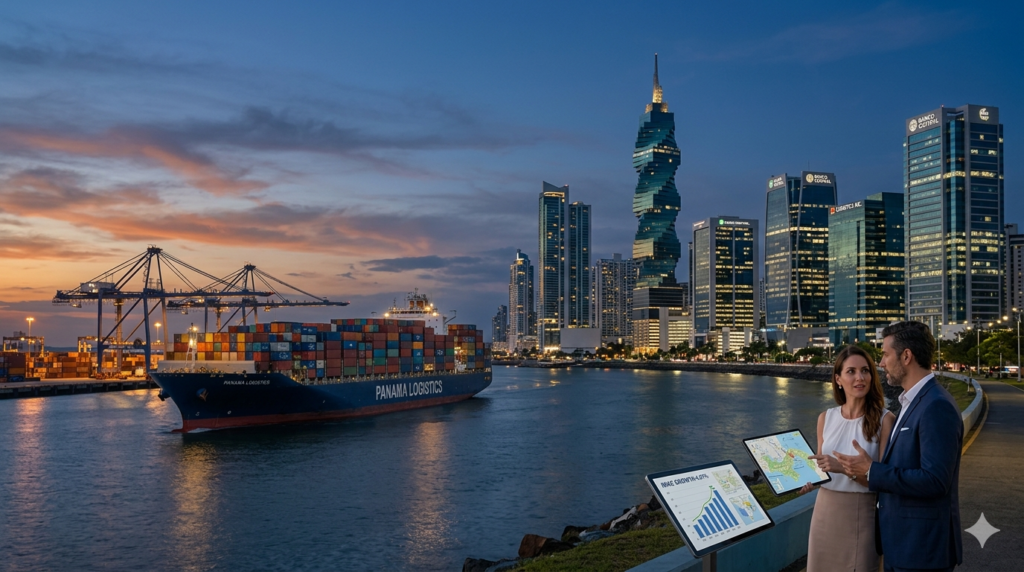
The January 2026 IMAE reading highlights a clear pattern: the bulk of growth is coming from transport, logistics, commerce, and financial services. These sectors benefit directly from Panama’s role as a regional logistics hub and a financial center, with elevated activity around the Canal, trade corridors, and the International Banking Center (IBC).
For expats and investors tied to property, retail, or small local services, this sectoral bias matters. The “growth story” is strongly skewed toward capital‑intensive, export‑oriented industries, while mass‑market retail and some segments of the formal private sector still feel the labor‑market “gaps” and thin margins mentioned in recent labor and business surveys.
4. Retail and labor “gaps” behind the scenes
Even as the IMAE grows, domestic retail and some service‑intensive sectors are not feeling the same momentum. Analysts note that consumer‑facing businesses—the kind that touch the daily life of residents—are still constrained by slower wage growth, persistent labor mismatches, and cautious household spending, despite the stable inflation backdrop.
In other words, while logistics and finance fuel the headline number, many small‑ and medium‑sized enterprises and retail employees are experiencing a more modest, even fragile, version of the 2026 recovery. This is the “brecha” or gap that policymakers and labor reports increasingly reference when discussing the Panama economic outlook.
5. A $117–118 billion banking safety net
Underpinning Panama’s stability is a powerful financial cushion: the International Banking Center (IBC) reports deposits of approximately USD 118.2 billion as of early 2026, up more than 7% year‑on‑year. This huge deposit base, paired with a strong credit dynamic, reinforces Panama’s role as a solid, trusted platform for savings and investment in Latin America.
For expats living under Panama’s balboa–dollar parity regime, this deposit strength feeds directly into exchange‑rate and financial‑system confidence. The combination of low inflation, stable prices, and a deeply capitalized banking system makes Panama one of the most stable currency and deposit environments in the region, even if the underlying growth story is concentrated in a few key sectors.
Conclusion: Growth is real, but not universally felt
Panama’s 4.07% IMAE growth at the start of 2026, combined with near‑zero inflation and a banking‑sector deposit base above USD 117 billion, confirms that the macro story is sound. The economy is expanding, and the financial system is robust enough to absorb shocks and support continued investment.
However, the benefits are not evenly distributed: logistics, transport, and finance are riding the wave, while retail‑focused workers and small businesses feel the “gaps” more acutely. For expats, the headline numbers are encouraging, but the real‑world impact depends heavily on sector, income structure, and exposure to imported goods and services. The message for 2026 is clear: Panama’s growth is real, but reaching your wallet depends on where you sit in the economic map.